People
FCE BUT graduate František Bílek: I consider the gold medal from the EXPO 2025 world exhibition in Osaka to be an exceptional achievement

Why did you decide to study at BUT? And why architecture?
I had been certain for a long time that I wanted to study in Brno and that it would be architecture. The only thing left was to decide between the Faculty of Architecture in Poříčí and the newly established architecture programme at the Faculty of Civil Engineering in Veveří. In the end, the Faculty of Civil Engineering won out, mainly for two reasons. The first was the direct confrontation of architecture with technical disciplines, which, in my experience, is highly valued especially in studios where graduates of this field later work. The second reason was the compulsory two-semester internship, which the Faculty of Architecture did not offer at the time.
How did your studies prepare you for your professional career?
The compulsory internship that was part of the programme was, in my opinion, the best possible preparation for professional life. I actually stayed at the studio where I completed it even after graduating and spent seven enriching years there. The studies themselves provide a solid theoretical foundation and introduce students to the process of preparing and developing projects. Each semester we worked in studio classes on projects linked to specific locations and addressed real-life problems of those places, which was great. The real confrontation with the reality of the construction approval process, however, only comes in practice. Perhaps it would be worth devoting more attention to this area during studies.
What do you remember most from your studies?
I would divide my memories into two levels – academic and extracurricular – although they naturally overlap at times. I most vividly remember working on projects in the studio and the joint consultations, where we spent a great deal of time together. We were also able to adapt the studio space to our own ideas – and as future architects, we naturally paid close attention to that.
What led you to the field of exhibition design? What was your professional journey?
The field of exhibition and exhibition design is not very well known and is often seen as a kind of “underdog” within architecture. Which is a pity, because it offers enormous space for creativity. And that was exactly what attracted me and challenged me. Another reason was a certain level of exhaustion – or perhaps rather a confrontation with the reality of Czech construction processes in practice. But that is a topic for another interview.
How do you use the knowledge gained during your studies at BUT in this field?
The subject of exhibition design was part of the curriculum during my studies, and I even completed one studio focused on it. In hindsight, however, I must say that real practice looks somewhat different and needs to be experienced firsthand. In this field, especially in exhibition design, we have to respond very quickly to current trends and client requirements. On the other hand, the creative process itself, the preparation of outputs and project coordination are very close to architecture, and without studying at BUT I would have found it much harder to acquire these skills.
How is this field developing? What role does the rapidly evolving AI play, and what is the role of the architect?
This field is very sensitive to social events and the current global situation. I feel that over the ten years I have been working in it, it has undergone a fundamental transformation. A typical example is the Covid period, during which exhibition activities practically came to a halt. Some trade fairs have also transformed over time from major international events into more private marketing presentations of individual brands, which is particularly evident in the automotive industry. In traditional architecture and construction, such fundamental changes usually occur much more slowly.
Artificial intelligence is influencing our field, and we are trying to respond to its development from the very beginning and actively use it in our work. In general, I perceive its impact rather positively. On the other hand, it opens up a wide space for creative proposals even by people without technical background, which sometimes leads to requests for the realization of concepts that contradict physical laws or material possibilities – not to mention their financial demands.
You have completed many successful projects – from furniture design to complete exhibition concepts. Could you tell us more about some of them?
It is not easy to select specific projects from all the years I have been working in the field. Each of them is meaningful to me – whether it is a single piece of furniture or large multi-storey exhibitions for major global brands. In recent years, we have devoted a lot of energy to projects for the World Expo in Osaka. We prepared designs, for example, for the Czech, Swiss, Slovak and French pavilions, and in some cases we narrowly missed winning the competitions. In the end, we celebrated twice at this year’s Expo. First, when we succeeded in the competition for the design and realization of the joint pavilion of the Nordic countries – the so-called Nordic Pavilion – and second, when this project won the top award, the Gold Medal for Best Exhibit or Display at the World Expolympics 2025. An international jury composed of more than thirty leading architects, designers and professionals from the exhibition industry worldwide selected the winners from projects representing more than 160 participating countries. Just to clarify, this pavilion represented five Nordic countries – Iceland, Norway, Sweden, Finland and Denmark.
How did you become involved in the NORDIC PAVILION project for Expo in Osaka?
The whole process began at the end of 2023, when we entered an international design & build tender for the design and delivery of the complete exhibition interior of an already designed pavilion. We assembled an international team of architects, designers, specialists in Japanese and Nordic culture and other experts, and went through several rounds of selection. We also involved architects from Finland, Denmark and Iceland, who helped us better understand the mentality and needs of the individual countries within their national presentations.
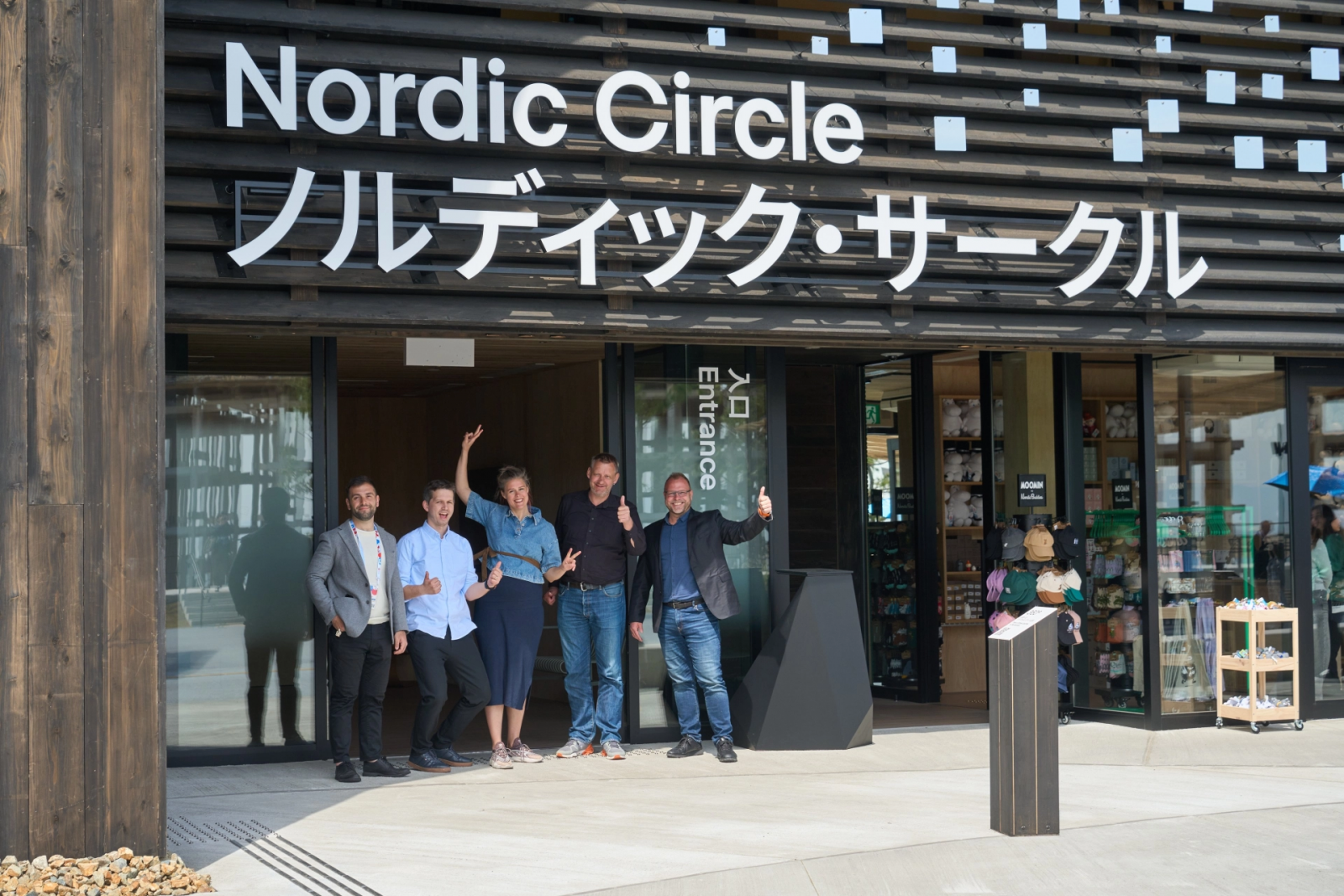
What makes the NORDIC PAVILION unique? What do you consider the most interesting aspect from an architectural point of view?
The greatest uniqueness lay in the fact that the pavilion had to present all five Nordic countries within a single exhibition. That was probably the biggest challenge and at the same time something truly exceptional within the whole Expo. It can be compared to designing a house for five siblings – each with their own identity – and having to find a way to present both their individuality and their unity. Fortunately, cooperation among all parties involved was very smooth in our case.
The Gold Medal for this project is a huge success. What do you think stood behind it, and what does this award mean to you personally?
I do not know the exact criteria on which the international jury based its decision. From my perspective, the main reason for our success was that we managed to create an exhibition with a simple and clearly readable design in a relatively small space, which presented all five countries as a coherent whole. Through various interactive elements, we were also able to inspire visitors with examples of how cooperation between the five countries works in practice. I see it as a truly exceptional achievement. Succeeding as a Czech company at the world’s largest international exhibition – and moreover within a foreign pavilion – is an accolade that is achieved only rarely in our field.
What professional or personal goals do you have for the future?
Professionally, I naturally have further goals I would like to achieve. In addition to participating in projects of global significance like the Nordic Pavilion at Expo, I work daily on various brand presentation projects around the world. At the same time, we are already beginning preparations for the specialised Expo in Belgrade in 2027 and for the next World Expo to be held in Riyadh, Saudi Arabia, in 2030.
What would you recommend to BUT students and graduates?
In general, it is difficult to give universal advice, as much depends on individual goals and focus. Personally, however, I believe it is important to remain open to new impulses and not to close oneself off in a creative bubble. Interaction with students from other faculties during studies, or later with colleagues across disciplines, helps greatly in this respect. And when speaking in the context of BUT, it is worth mentioning the alumni portal vutalumni.cz, which is an excellent tool, for example, for networking.
Source: BUT Alumni Portal
Graduates of BUT are contributing to a revolution in logistics. They are preparing infrastructure of delivery of parcels by drones
BUT startup LR SmartWater is digitizing Czech heating industry. Their models will also help water utilities and cities
From construction to his own company: Jiří Pech shows that BUT opens up much broader opportunities than it may seem
Jiří Sázel: "After 18 years of working in the Himalayas, it is no longer a problem for me to meet a person on every corner in Ladakh whose life has been changed by our work."
Conductive materials from FCE to ground buildings and warm up roads